
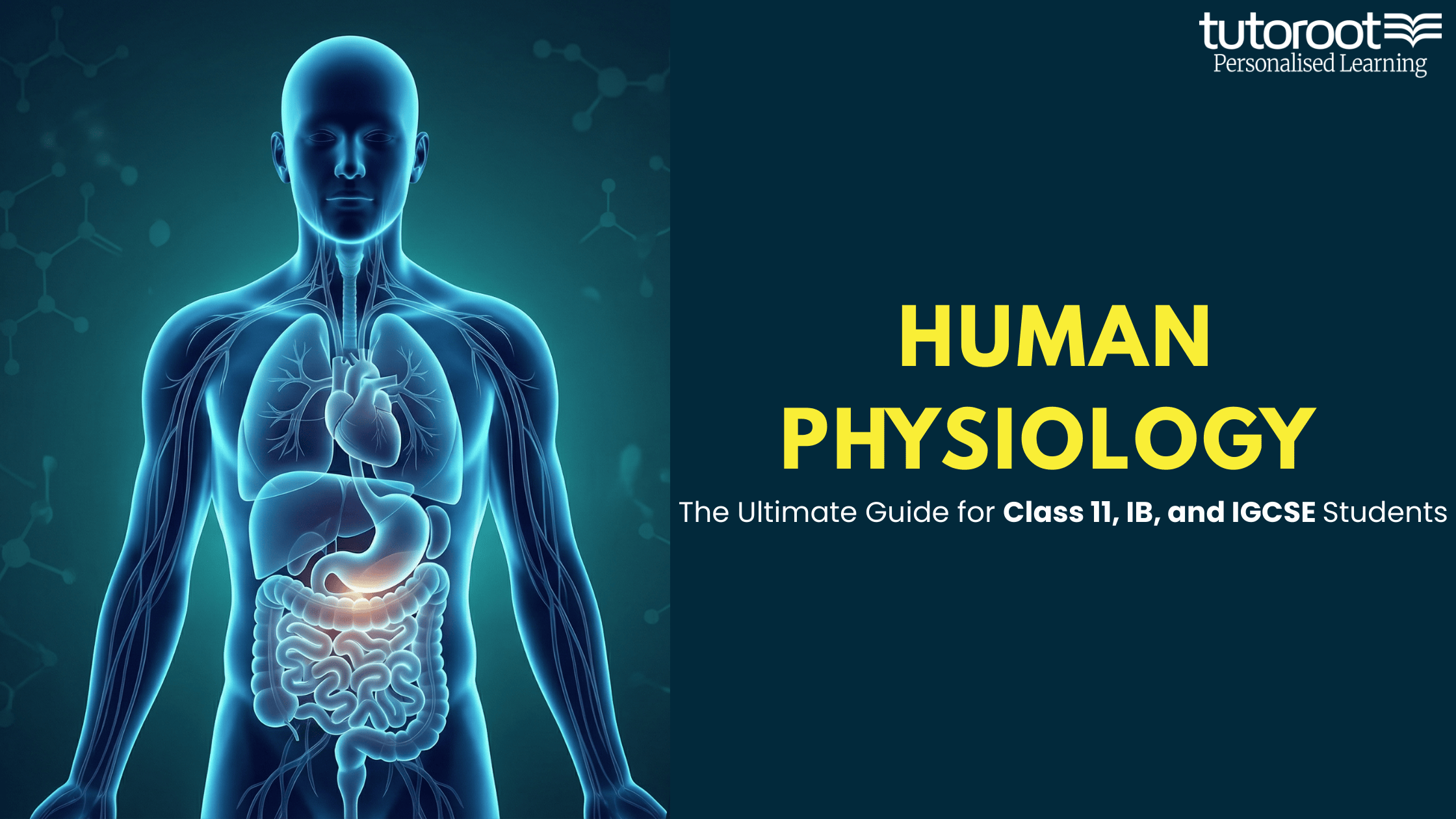
Human Physiology: The Ultimate Guide for Class 11, IB, and IGCSE Students
What is Human Physiology? Human physiology is the scientific study of the mechanical, physical, and biochemical functions of humans in good health. Human anatomy and physiology are frequently grouped together; however, physiology remains a distinct field. In particular, it investigates how systems like the respiratory and nervous systems operate. By focusing on the cellular and molecular levels, physiology explains the essential mechanisms that maintain homeostasis.
Why Human Physiology is the Core of Biology
Understanding the “how” behind the human body is the most critical part of any biology curriculum. Mastering these systems is essential for students navigating the Class 11 NEET syllabus. In addition to NEET preparation, these systems are vital for the IB Biology HL exam. In fact, the depth required for both is quite high. For this reason, you must engage in consistent practice to ensure success in these competitive academic paths.
Many students struggle with the transition from simple memorization (Anatomy) to complex process understanding (Physiology). This guide breaks down the high-weightage systems and provides the exact resources you need to score a Level 7 or a perfect grade.
Human Physiology: Quick Overview of Major Systems
To master human anatomy and physiology, you must understand the 11 organ systems. Below is a summary of the systems most frequently tested in global exams:
| System | Primary Function | Key Concepts for Exams |
| Circulatory | Transport of nutrients/oxygen | Cardiac Cycle, Double Circulation |
| Respiratory | Gas exchange ($O_2$ and $CO_2$) | Alveoli, Partial Pressure |
| Digestive | Breakdown of food | Enzyme Action, Absorption |
| Nervous | Signal transmission | Action Potentials, Synapses |
| Excretory | Waste removal | Osmoregulation, Nephron function |
Detailed Breakdown: The “Big Three” Systems
A. The Circulatory System
In Human Physiology Class 11 and IB, the heart is a top priority topic. You must understand the flow of blood and the electrical conductivity that triggers heartbeat.
B. The Respiratory System
Focus on the mechanism of breathing and the “Oxygen-Haemoglobin Dissociation Curve.” This is a “High-Information” area that frequently appears in advanced papers.
C. The Nervous System
This system is about electrical communication. Understanding the Sodium-Potassium Pump and how a nerve impulse jumps across a synapse is vital for scoring high.
Human Physiology Class 11 (CBSE/NEET Focus)
For Indian students, the Human Physiology Class 11 unit is the “heavyweight” of the Biology paper, accounting for nearly 20% of the marks.
The 7 Pillars: Digestion, Breathing, Body Fluids, Excretion, Locomotion, Neural Control, and Chemical Coordination.
Strategy: Don’t just read the NCERT; practice the diagrams. Labeling the parts of a Nephron or the Sarcomere (muscle unit) is where most marks are earned.
Is the Curriculum Different for IB and IGCSE?
While the biology is the same, the testing is different:
IB Biology: Focuses on data analysis. You might be asked to interpret a graph of lung volume during exercise.
IGCSE: Focuses on clear definitions and the “pathway” of substances (e.g., the path of a red blood cell).
CBSE: Focuses on terminology and the biological “why” behind human health conditions.
Recommended Human Physiology Books for 2026
If you are looking for a reliable human physiology book, here are the top three recommendations based on your curriculum:
-
Medical Physiology: Guyton and Hall is widely considered the “gold standard” for general excellence in the field.
-
IB Diploma: Students should rely on the Oxford IB Biology Course Companion for accurate curriculum alignment.
-
Secondary Education (Class 11): Use NCERT Biology as your primary text, but keep Trueman’s Elementary Biology handy for supplementary reading.
Study Strategy & High-Scoring Tips
Master Homeostasis: Almost every physiology answer should mention how the body maintains a “steady state.”
Draw Flowcharts: Instead of writing paragraphs on how blood clots, draw a flowchart of the Enzyme Cascade.
Learn the Graphs: In human anatomy and physiology, graphs (like the ECG or Action Potential curve) carry as much weight as text.

FAQs on Human Physiology
Q1.What is the difference between Anatomy and Physiology?
Anatomy is the study of structure (naming the heart valves or bone types), while Physiology is the study of the function (how those valves open due to pressure or how bones produce blood cells).
Q2.Why is Section B (Numerical Questions) so difficult in Class 11 exams?
Students often struggle because Section B requires a precise “integer or decimal” answer with no multiple-choice options. In exams like NEET or JEE, these often focus on calculations like Cardiac Output ($Stroke Volume \times Heart Rate$) or Partial Pressures in respiration.
How do I memorize the different types of joints for my exam? Use the “Mnemonic Method”:
- Hinge = Hand (Fingers/Elbow).
- Ball & Socket = Big movements (Shoulder/Hip).
- Saddle = Side-to-side (Thumb).
- Pivot = Point (Neck).
Q3.Is there negative marking for “Numerical Value” questions in Human?
Physiology? Yes. Under the 2025–2026 updated rules for major competitive exams (like NEET/JEE), even numerical entry questions in Section B carry a -1 negative marking penalty. Accuracy is now more important than ever.
Q4.Which chapter has the highest weightage in Human Physiology Class 11?
Statistically, Chemical Coordination and Integration (Hormones) and Neural Control (The Brain/Nerve Impulse) have the highest weightage and are the most frequent sources of “Hard” difficulty questions.
Q5.How can I interpret Oxygen-Haemoglobin Dissociation curves in IB Biology?
Remember the “Bohr Shift.” When $CO_2$ levels increase (during exercise), the curve shifts to the right, meaning haemoglobin has a lower affinity for oxygen and releases it more easily to the hardworking muscles.
Q6.Are diagrams mandatory in physiology exams?
Yes. Additionally, whether you take CBSE or IB exams, diagrams play a major role. Indeed, a well-labeled diagram can earn you full marks even if your written text is brief. As a result, this is a top strategy for exam success. Always practice drawing the Nephron, the Heart, and the Reflex Arc.
Boost Your Scores withTutoroot
Mastering Human Physiology doesn’t have to be a struggle. At Tutoroot, we provide one-on-one sessions tailored to IB, IGCSE, and Class 11 curriculums. Our expert tutors use 3D visualizations to help you “see” the systems in action.