
What is Nitrogen Cycle? Stages, Diagram & Importance
For an ecosystem to survive and thrive, various parameters are important, one such parameter is the natural nitrogen process makes nitrogen more useful to all plants and living organisms. However, this biogeochemical process involves multiple complex stages, which are complex to understand. So, to help students in this regard, we have put together a detailed guide on the nitrogen cycle, and the various stages involved in it. Not just that, we will also help you understand the importance of the nitrogen cycle for plants, living animals, and the ecosystem.
What is the Nitrogen Cycle?
The nitrogen cycle is a biogeochemical process that converts inert atmospheric nitrogen into usable forms.
Plants and living organisms use these forms for growth and survival.
According to standard biology references, nitrogen is essential for proteins and DNA formation in living organisms.
Moreover, the nitrogen cycle as said above involves multiple processes such as putrefaction, denitrification, nitrification, nitrogen fixation, and decay. Besides, nitrogen exists in two forms in nature, sustainable or organic nitrogen, and inorganic nitrogen. Furthermore, the inorganic nitrogen in the atmosphere is more abundant compared to organic nitrogen. And because of the Nitrogen cycle, the abundant inorganic nitrogen is converted into organic nitrogen and it is passed up into the food chain to balance the ecosystem.
Nitrogen Cycle Diagram
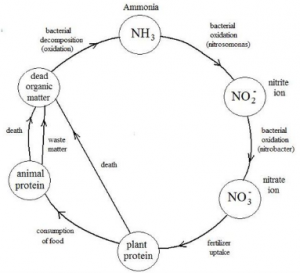
From the above diagram of the nitrogen cycle, you can observe the different processes involved in the nitrogen cycle, and how the nitrogen gas in the atmosphere is converted into organic nitrogen.
Importance of Nitrogen Cycle
From the above description, you can guess, that the nitrogen cycle is very important. And here in this section, we will list some of its significance or contributions to the ecosystem.
- As we begin to narrate the importance of the nitrogen cycle, the first point that has to be essentially noted is that the nitrogen cycle causes biochemical processes, which help inert nitrogen gas to get converted into a usable form for plants.
- Nitrogen plays a crucial role in cell formation and helps build essential biomolecules.
- The Photosynthesis process in plants involved chlorophyll, is possible only because of the nitrogen compounds.
- Moreover, the nitrogen cycle also causes the ammonification process, which involves bacteria that converts animal and plant platter, through decomposition.
- Due to the nitrogen cycle, nitrates and nitrites are released into the soil, which will boost productivity of the soil.
As per the importance of the nitrogen cycle, let us note that activities, such as fuel combustion, and the use of fertilizers with nitrogen content also lead to the cycling of nitrogen. In these cases, nitrogen-holding compounds increase in their levels in the atmosphere. As nitrogen converts itself into compounds, its abundance in the atmosphere can be effectively harnessed. Because plants use nitrogen compounds immensely.
Stages of Nitrogen Cycle
As explained above, there are multiple stages in the Nitrogen Cycle, which we are going to explain briefly here in this section.
Nitrogen Fixation Process
Nitrogen fixation is the first step in the nitrogen cycle. This process takes multiple steps, First, the conversion of atmospheric nitrogen (N2) into inert form, which is then converted into Ammonia (NH3). By the end of this process, the nitrogen is deposited into the soil and surface waters, mainly by precipitation. Moreover, the nitrogen fixation process is possible only because of a symbiotic bacteria called Diazotrophs. Aside from these various other bacteria like Rhizobium and Azotobacter can also be used in this process. As explained, these bacteria are stored in the roots of the leguminous plants and they aid in converting inert nitrogen into ammonia. Apart from this, lightning and artificial methods can also be used for the nitrogen fixation process.
Nitrogen fixation occurs through lightning, biological activity, and industrial processes.
Industries produce ammonia using high temperature and pressure. This forms the prelude in understanding the importance of the nitrogen cycle.
Nitrification
The nitrification happens in two steps. The ammonia deposited into the earth’s atmosphere is converted into nitrate with the help of the bacteria in the soil. Now the nitrites formed are transformed into the oxidation of the ammonia process, with the help of Nitrosomonas bacteria species. Then Nitrobacter is used to convert the nitrites into nitrates. The bacteria get energy with this transformation.
2NH3 + 3O2 → 2NO2– + 2H+ + 2H2O
2NO2– + O2 → 2NO3–
Assimilation
This is the process that explains how plants absorb nitrogen from the roots. The Nitrates, Nitrites, and ammonium compounds enter the plants through the soil and help them develop, grow, and evolve. In this way, these components make their way into the food chain.
Ammonification
When plants and animals die, decomposing organisms release ammonium into the soil. However, this process is possible only because of the virus and bacteria present in the soil.
Denitrification
This is known as the reverse process of nitrification and it occurs in the deeper crests of the soil where bacteria convert NO3- to N2 and other gaseous compounds such as NO2.
After a point of time, the nitrogen components in the plants and soil ecosystems are transferred back into the air through the denitrification process. This method involves converting nitrate (NO3-) into Nitrogen in the gaseous form. However, one thing the students must remember is that there is no oxygen present during this process.
Learn Biology Better with Personalised Online Tuition
In the above article, we explored the nitrogen cycle, its stages, and its importance in maintaining ecosystem balance. While such Biology concepts can feel complex, learning becomes much easier with the right guidance.

Tutoroot offers personalised online Biology tuition designed to help students understand concepts clearly, improve exam confidence, and perform better academically. With expert tutors, one-to-one attention, and flexible learning schedules, students can master Biology without stress.
FAQs
Q1. What is the Nitrogen Cycle?
The nitrogen cycle is a biogeochemical process that converts atmospheric nitrogen into usable forms that plants and animals need for growth and survival.
Q2. Explain the Nitrogen Cycle in simple terms.
The nitrogen cycle explains how nitrogen moves from the atmosphere into the soil, plants, animals, and back into the air. Through natural processes like nitrogen fixation, nitrification, assimilation, ammonification, and denitrification, nitrogen becomes useful for living organisms and helps maintain ecosystem balance.
Q3. Why is the Nitrogen Cycle important?
The nitrogen cycle is important because it supplies essential nitrogen compounds needed for plant growth, protein formation, and DNA synthesis. Without this cycle, life on Earth would not be sustainable.
Q4. Can nitrogen be converted into oxygen?
No, nitrogen cannot be directly converted into oxygen. They are two different chemical elements. However, nitrogen can form various compounds during natural processes, while oxygen is produced mainly through photosynthesis.
Q5. Which organisms play a major role in the Nitrogen Cycle?
Microorganisms such as bacteria (Rhizobium, Nitrosomonas, and Nitrobacter) play a key role by converting nitrogen into different usable forms at various stages of the cycle.
Visit Tutoroot Social Platforms:





The point of view of your article has taught me a lot, and I already know how to improve the paper on gate.oi, thank you. https://www.gate.io/ru/signup/XwNAU
Good explanation
Notice are well elaborate and understood
Thanks for sharing. I read many of your blog posts, cool, your blog is very good. https://accounts.binance.com/ru-UA/register?ref=OMM3XK51
Detailed and informative 👌