
Magnetic Effect of Electric Current – Explanation, Diagram & Class 10 Notes
What is Magnetic Effect of Electric Current?
It refers to the phenomenon where a magnetic field is produced around a conductor when electric current flows through it.
This discovery was first made by Hans Christian Oersted, who observed that a compass needle deflected when placed near a current carrying wire.
Examples include:
- electric motors
- generators
- electromagnets
- transformers
Understanding this concept is very important for CBSE Class 10 Physics and competitive exams like JEE and NEET.
How Does Magnetic Effect of Electric Current Work?
When electric current flows through a conductor, moving electrons create a magnetic field around the wire.
The direction of this magnetic field can be determined using the Right Hand Thumb Rule.
According to this rule:
- If the thumb points in the direction of current
- The curled fingers represent the direction of magnetic field lines.
This rule helps students understand the orientation of magnetic fields around current carrying conductors.
Magnetic Field Around a Current Carrying Conductor
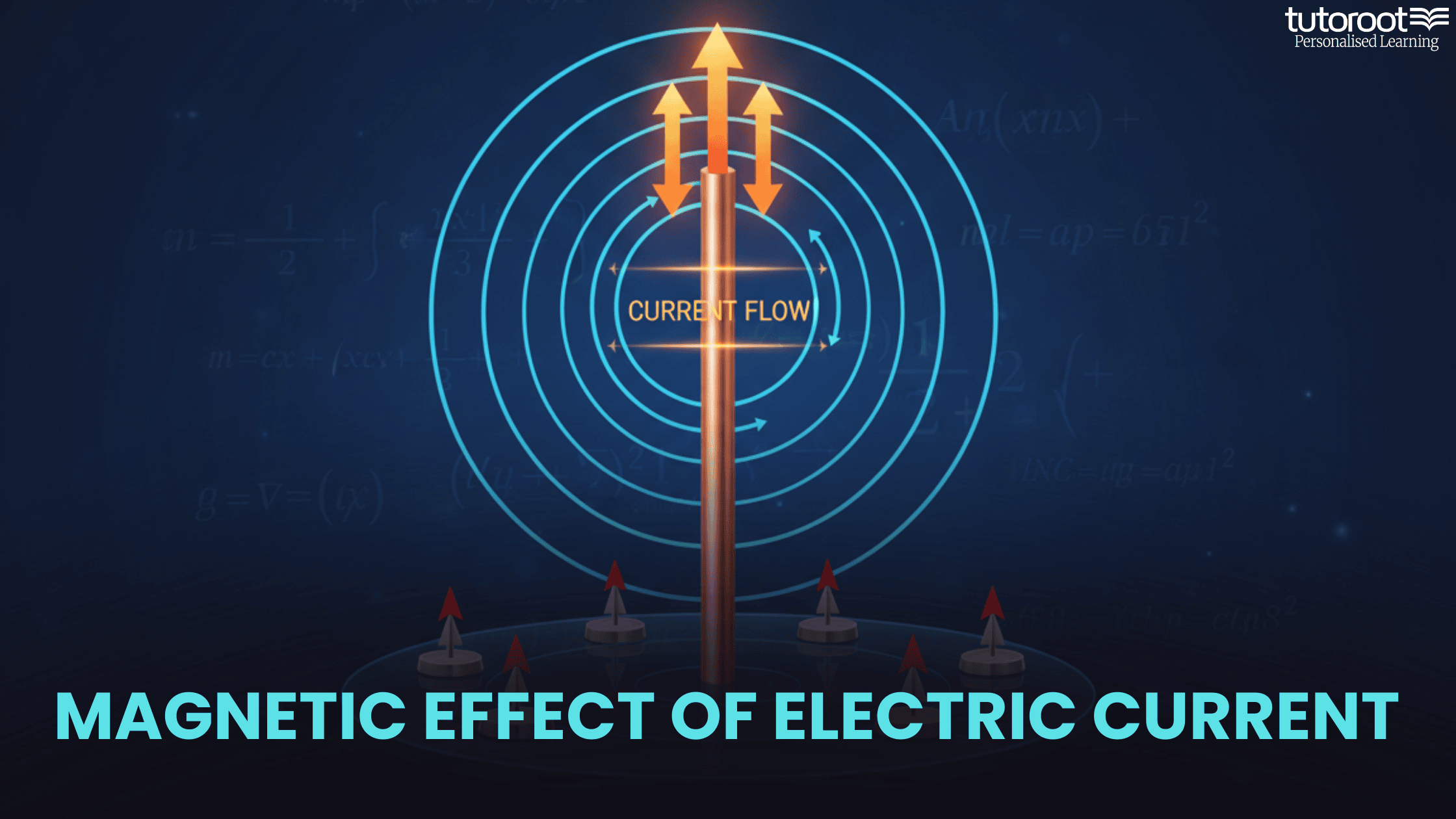
A current carrying wire produces circular magnetic field lines around it.
Important characteristics include:
- Magnetic field lines form concentric circles
- Strength of the magnetic field decreases as distance increases
- The field becomes stronger when current increases
These magnetic fields can interact with other magnetic fields to produce mechanical motion in devices such as motors.
Magnetic Effect of Electric Current in Solenoid
A solenoid is a long coil of wire through which current flows.
When electric current passes through a solenoid:
- It behaves like a bar magnet
- One end becomes a north pole
- The other end becomes a south pole
Because of this property, solenoids are used to create electromagnets.
Electromagnets are used in:
- electric bells
- magnetic cranes
- electric relays
Applications of Magnetic Effect of Electric Current
It has many practical applications.
Some common uses include:
Electric Motors
Motors convert electrical energy into mechanical motion using magnetic forces.
Electromagnets
Electromagnets are used in cranes to lift heavy iron objects.
Electric Generators
Generators use magnetic fields to produce electricity.
Transformers
Transformers change voltage levels in power transmission systems.
Why Students Find This Topic Difficult
Many students struggle with this topic because it includes:
- right hand thumb rule
- magnetic field diagrams
- electromagnet concepts
- applications of magnetic fields
However, learning these concepts becomes easier with proper guidance and visual explanations.
Learn Physics Easily with Tutoroot
Many students find physics topics like magnetic effect of electric current, electromagnetism, and electric circuits difficult to understand through textbooks alone.
Tutoroot provides personalized one-to-one online tuition for CBSE, IB, IGCSE, JEE, and NEET students where expert teachers explain complex physics concepts using diagrams, examples, and step-by-step methods.
Students receive:
-
Live Online Classes: Real-time interaction with subject matter experts.
-
Concept Clarity Sessions: Deep dives into fundamental laws of physics.
-
Doubt-Solving Support: Instant clarification for homework and textbook problems.
-
Guidance for Success: Proven preparation techniques for board and entrance exams.

👉 Book a FREE demo class today
-
FAQs
What is the magnetic effect of electric current?
The magnetic effect of electric current is the phenomenon where a magnetic field is produced around a conductor when electric current flows through it.
Who discovered the magnetic effect of electric current?
The magnetic effect of electric current was discovered by Hans Christian Oersted in 1820.
What is the right hand thumb rule?
The right hand thumb rule helps determine the direction of magnetic field around a current carrying conductor.
What is a solenoid in physics?
A solenoid is a long coil of wire that produces a strong magnetic field when electric current flows through it.
What are the applications of magnetic effect of electric current?
It currently is using in electric motors, generators, electromagnets, transformers, and electrical appliances.