
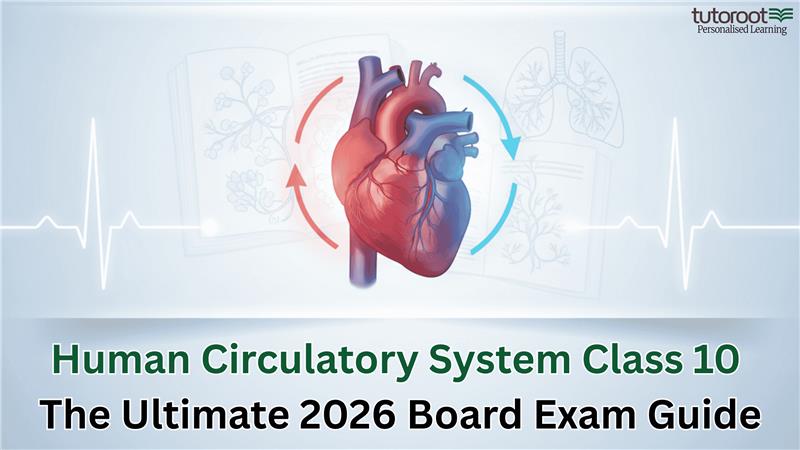
Human Circulatory System Class 10: The Ultimate 2026 Board Exam Guide
The human circulatory system is also called as the “delivery network” of our bodies. In the Class 10 Science curriculum, this system is a cornerstone of the “Life Processes” unit. While students prepare for the upcoming papers, understanding the complex interplay between the heart, blood and vessels is not just about memorization, it is about understanding the “why” and “How” of human survival.
1. The Anatomy of the Human Circulatory System
The circulatory system of human body consists of three primary components: a pump (the heart), a medium (blood), and a network of tubes (blood vessels).
The Heart: Our Muscular Pump
The human heart is roughly the size of a fist and is divided into four chambers to prevent the mixing of oxygen-rich and carbon-dioxide-rich blood.
Atria (Auricles): The two thin-walled upper chambers that receive blood.
Ventricles: The two thick-walled lower chambers that pump blood out with force.
2. Master the Human Circulatory System Diagram
The HCS diagram is one of the important questions asked questions for 5-marks every year. Examiners look for specific anatomical markers that prove you understand the flow of blood.
Your Diagram Checklist:
The Septum: The muscular wall that separates the right and left sides.
Major Vessels: Clearly label the Aorta (oxygenated blood to body), Vena Cava (deoxygenated blood to heart), Pulmonary Artery (to lungs), and Pulmonary Vein (from lungs).
3. Why the Human Double Circulatory System is a “Rank-Decider”
A topic currently trending in student forums is the human double circulatory system. In humans, blood passes through the heart twice for every single complete circuit of the body.
Pulmonary Circulation: Blood travels from the heart to the lungs for oxygenation and back.
Systemic Circulation: Oxygenated blood travels from the heart to the rest of the body and returns as deoxygenated blood.
Why is it necessary? Humans are warm-blooded and have high energy needs. The human double circulatory system ensures a highly efficient supply of oxygen by keeping oxygenated and deoxygenated blood completely separate. This allows us to maintain a constant body temperature regardless of our environment.
4. Components of the Human Blood Circulatory System
The human blood circulatory system uses blood as its transport fluid. Blood is a connective tissue composed of:
Plasma: A straw-colored liquid that transports $CO_2$, nutrients, and nitrogenous wastes.
RBCs (Erythrocytes): Contain hemoglobin, which has a high affinity for oxygen.
WBCs (Leucocytes): The “soldiers” of the body that fight infections.
Platelets: Essential for blood clotting to prevent pressure loss in the system.
5. FAQ: Real-World Queries from Student Communities
Q1: Why does the left ventricle have thicker walls than the right ventricle?
The left ventricle must pump blood to the entire body (Systemic Circulation) under high pressure, whereas the right ventricle only pumps blood to the nearby lungs.
Q2: Which blood vessel is the only vein to carry oxygenated blood?
The Pulmonary Vein is the unique exception; it carries oxygen-rich blood from the lungs back to the left atrium.
Q3: What is the role of valves in the human circulatory system?
Valves ensure that blood flows in only one direction, preventing any backflow when the heart chambers contract.
Q4: What is the significance of “Double Circulation” in mammals?
It allows for the complete separation of oxygenated and deoxygenated blood, ensuring high efficiency in oxygen delivery for energy-intensive tasks.
Q5: How does the SA Node function as a pacemaker?
The Sinoatrial (SA) node generates rhythmic electrical impulses that trigger the heart’s contraction, setting the natural pace of the heartbeat.
Q6: What is the difference between an artery and a vein?
Arteries carry blood away from the heart at high pressure (thick, elastic walls), while veins carry blood toward the heart at low pressure (thin walls, contain valves).
Conclusion
As you finalize your Class 10 Science revision, stop reading and start drawing. A perfect human circulatory system diagram is your ticket to a full 5 marks. Focus on the labels and the direction of the arrows; these are what evaluators scan for first.
At Tutoroot, we turn these complex “Life Processes” into visual wins. Whether you need a 30-minute doubt session or the most repeated board questions, our experts are here to help you dominate the 2026 exams.