
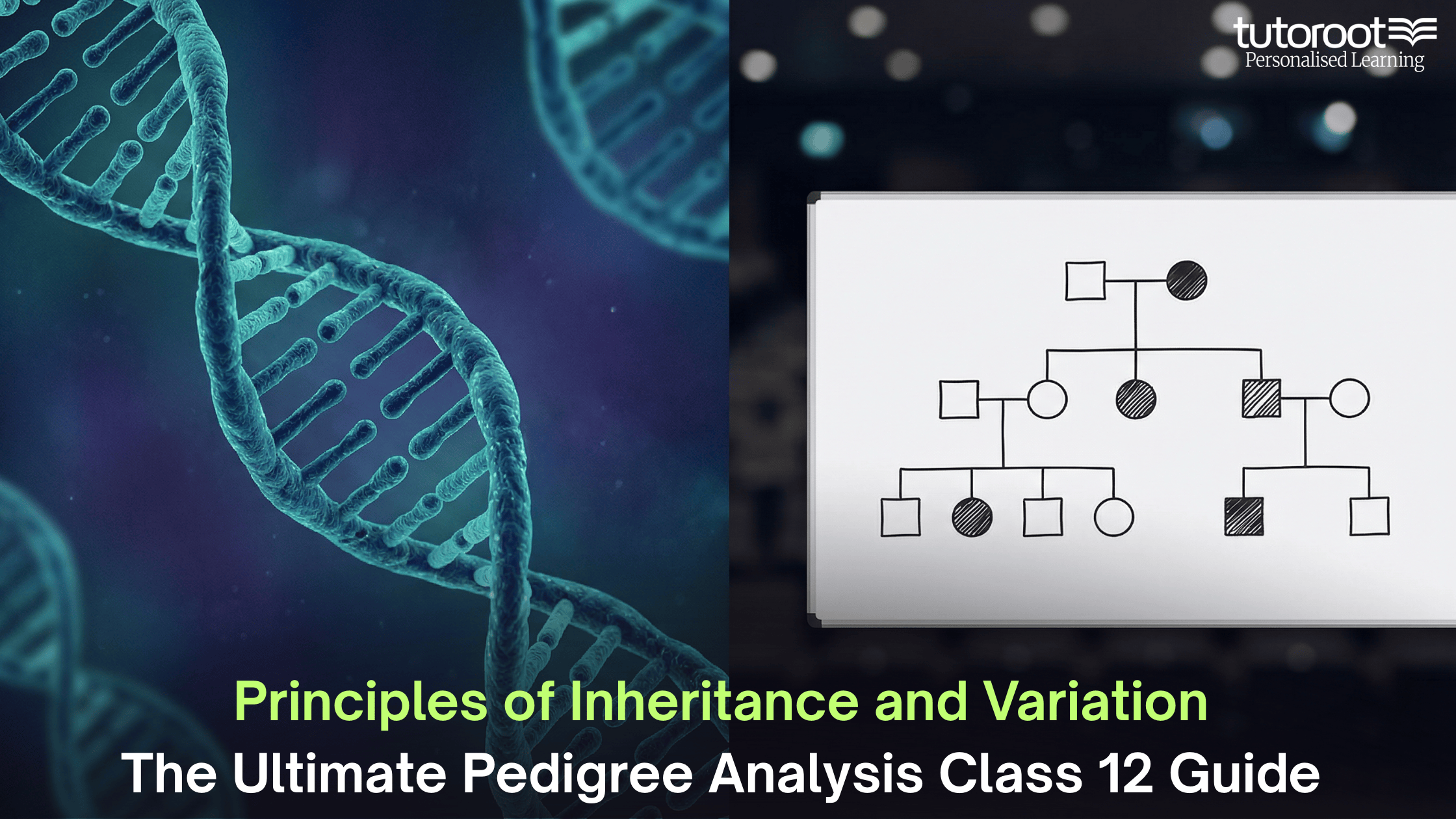
Principles of Inheritance and Variation: The Ultimate Pedigree Analysis Class 12 Guide
What is Pedigree Analysis in Class 12 Biology?
Pedigree analysis is a specialized branch of genetics that uses a family tree (pedigree chart) to track the inheritance of specific traits or genetic disorders over multiple generations. In the Principles of Inheritance and Variation chapter, it serves as a critical diagnostic tool to determine if a trait is autosomal or sex-linked, and whether it follows a dominant or recessive pattern. This is essential for genetic counseling and is a high-weightage topic for NEET and CBSE Class 12 exams.
The 40-Year Perspective on Genetics
In my four decades of teaching Biology, I have noticed a consistent trend: students can easily memorize Mendel’s 3:1 ratio, but they hit a wall when those ratios are transformed into a family tree. Principles of Inheritance and Variation is the foundation of modern medicine.
Whether you are aiming for a top rank in NEET or a perfect score in your CBSE Class 12 boards, Pedigree Analysis is your “litmus test” for logical reasoning. In this guide, we will strip away the confusion and provide you with a systematic framework to solve even the most complex pedigree analysis questions.
Why We Use Pedigree Analysis in Human Biology
In subjects like Botany, we can perform “test crosses” to observe inheritance. However, in human Biology, controlled breeding is unethical and impossible. Also, families of people usually have only a few children, thus it’s hard to find statistical ratios (such 9:3:3:1) in one household.
This is why we use Pedigree Analysis. It allows us to look backward through history to predict the future. For a Class 12 student, this isn’t just a chapter; it’s a tool used by doctors to predict the likelihood of a child inheriting life-altering conditions.
Decoding the Language: Symbols & Charts
You cannot solve pedigree analysis questions if you don’t speak the language. A pedigree chart is a map, and these symbols are your legend:
Unshaded Square: Normal Male.
Unshaded Circle: Normal Female.
Fully Shaded Shape: Affected Individual.
Half-Shaded Shape: Carrier (usually for recessive traits, though not always shown in exam papers).
Diamond: Gender unspecified.
Horizontal Line between Square & Circle: Mating/Marriage.
Vertical Line leading down: Offspring (listed left to right in birth order).
The Master 3-Step Strategy for Pedigree Analysis
You need a protocol if you want to tackle these tasks in less than 60 seconds during a test.. Here is the “Veteran’s Shortcut”:
Step 1: The Dominance Test (Check for Generation Skipping)
The most important question is: Does the trait disappear and then reappear?
Recessive Trait: If you see two “normal” parents having an “affected” child, the trait is Recessive. This is because the parents were hidden carriers ($Aa$).
Dominant Trait: If every affected child has at least one affected parent, the trait is Dominant. Dominant traits do not “hide.”
Step 2: The Gender Bias Test (Autosomal vs. Sex-Linked)
Now, look at who is getting sick.
Autosomal: If males and females are affected roughly equally, it is located on chromosomes 1–22.
X-Linked Recessive: If mostly males are affected, it is likely on the X-chromosome.
Expert Tip: If a mother is affected, all her sons must be affected in an X-linked recessive pattern. If even one son is healthy, it is Autosomal.
Step 3: The Cross-Check (Genotype Assignment)
Once you have a theory (e.g., “This is Autosomal Dominant”), assign letters to the people in the chart ($AA, Aa,$ or $aa$). If the math works for the whole family, you have solved the pedigree analysis.
Deep Dive: High-Weightage Disorders (NCERT Specific)
For CBSE and NEET, the examiners focus on a few specific disorders mentioned in the Principles of Inheritance and Variation Class 12 NCERT textbook. Memorizing these patterns will save you time:
A. Haemophilia (X-Linked Recessive)
Known as the “Royal Disease,” it shows a “Criss-Cross” inheritance. An affected father passes the gene to his daughter (who becomes a carrier) and she passes it to her son (who becomes affected).
B. Sickle Cell Anemia (Autosomal Recessive)
This trait only appears when both parents are at least carriers. In pedigree analysis questions, look for parents who are “normal” but have a child with the disease.
C. Myotonic Dystrophy (Autosomal Dominant)
This is a classic “Vertical Inheritance” pattern. It does not skip generations. If you see it in the grandmother, the father, and the son, it’s a dominant trait.
Common Student Traps & How to Avoid Them
In 40 years, I’ve seen the same three mistakes repeated:
The “Mostly Male” Fallacy: Just because 3 out of 4 affected people are male doesn’t guarantee it’s X-linked. It could be a small sample size. Always check if an affected father has an affected son; if he does, it cannot be X-linked recessive.
Ignoring the Key: Some Pedigree Analysis Class 12 questions provide a specific key. Always read it first; don’t assume the shading means “affected” unless the key says so.
Over-complicating: Usually, exam questions follow Mendelian logic. Don’t look for rare mutations unless the standard rules fail.
Practice Section: Sample Pedigree Analysis Questions
To truly master the Principles of Inheritance and Variation, let’s look at a hypothetical scenario:
Question: A family chart shows that a trait is present in every generation. An affected father has four children: two affected daughters and two unaffected sons. What is the pattern?
Analysis: * No generation skipping = Dominant.
Father passes to all daughters but no sons = X-linked Dominant.
Verdict: X-linked Dominant Inheritance.

FAQ’S
Q1. My child understands Mendel, so why are they failing Pedigree Analysis questions?
A. The shift from clear 3:1 pea ratios to small human family sizes is difficult. In humans, we don’t see perfect ratios in a single family; we see the probability of that ratio, which requires logical elimination rather than simple math.
Q2.How do I distinguish between Autosomal Recessive and X-Linked Recessive in a small chart?
A.Look at the sons of an affected mother; in X-linked recessive, all sons must be affected. If you see a healthy son with an affected mother, the trait is immediately identified as Autosomal Recessive.
Q3.Does a ‘generation skip’ always mean the trait is recessive?
A. In the Class 12 and NEET syllabus, yes. If you see two healthy parents producing an affected child, it is the textbook definition of a Recessive pattern where the parents were hidden carriers.
Q4.Which specific pedigree charts are mentioned in the NCERT Class 12 book?
A,NCERT highlights two specific charts: Myotonic Dystrophy (Autosomal Dominant) and Sickle-Cell Anemia (Autosomal Recessive). Examiners often use these exact diagrams in the CBSE board exam, so mastering their patterns is essential.
Q5.Is Pedigree Analysis important for the NEET 2026 Biology section?
A.Absolutely, as it is a high-weightage topic that often combines chart logic with probability. Mastering this is essential for a 340+ score, as these questions test your ability to apply Principles of Inheritance and Variation to real data.
Conclusion: Why You Need an Expert Mentor
Genetics is a game of logic. One small error in your logic gate, and your entire ratio is wrong. At Tutoroot, we don’t just teach you to memorize the Principles of Inheritance and Variation; we teach you how to think like a geneticist. Our Biology mentors specialize in breaking down complex Pedigree Analysis into simple, repeatable steps.
[Struggling with your Genetics score? Book a Free Demo Class at Tutoroot and solve your first Pedigree chart with us today!]