
Electrochemical Cell – Diagram, Working Principle & Examples
Electrochemical cells are significant in the study of chemistry as it is a device that converts chemical energy into electrical energy. The concept of electrochemical cells is usually taught in the study of chemistry for students of Class 12 CBSE, IIT-JEE, and NEET.
Studying about electrochemical cells will give you an idea of how battery operates how electricity generated from a chemical reaction and how scientists use it to observe oxidation-reduction reactions.
In this whole blog, you will learn the definition, principle, diagram, half-reactions, and examples of electrochemical cells.
What is an Electrochemical Cell?
An electrochemical cell is a device used to produce electricity through a chemical reaction.
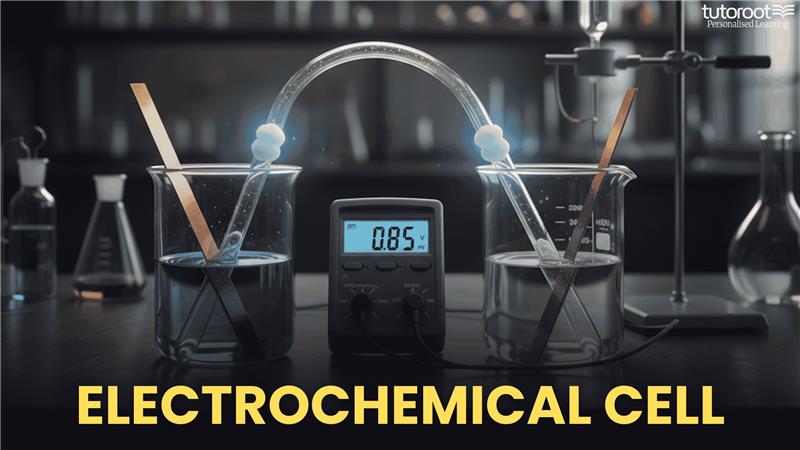
Two electrodes are dipped into two different solutions within an electrochemical cell. A chemical reaction takes place between these electrodes. This chemical reaction causes electrons to flow through an external source to produce electricity.
This is achieved through redox reactions. In these reactions, one compound loses electrons, and another compound gains electrons.
This flow of electrons causes chemical energy to convert into electrical energy.
Electrochemical Cell Diagram
It consists of several key components.
Main Parts of an Electrochemical Cell
- Anode
Oxidation occurs at the anode. Electrons are released during this reaction.
- Cathode
Reduction occurs at the cathode. Electrons are accepted here.
- Electrolyte
The electrolyte allows ions to move between electrodes.
- Salt Bridge
The salt bridge maintains electrical neutrality by transferring ions from the solutions.
These parts make sure that the flow of electrons in the circuit is continuous.
Working Principle of an Electrochemical Cell
The working principle is based on oxidation and reduction.
First, oxidation takes place at the anode. The electrons are released during oxidation. These electrons are then passed through the external circuit to the cathode.
Then reduction takes place at the cathode.
This flow of electrons through the circuit is called an electric current.
Half Reactions in an Electrochemical Cell
It consists of two half reactions.
H3: Oxidation Reaction
Oxidation happens when a substance loses electrons.
Example
Zn → Zn²⁺ + 2e⁻
Reduction Reaction
Reduction occurs when a substance gains electrons.
Example
Cu²⁺ + 2e⁻ → Cu
Together, these two half reactions generate electrical energy in the electro
Difference Between Electrochemical Cell and Electrolytic Cell
| Feature | Electrochemical Cell | Electrolytic Cell |
| Energy Conversion | Chemical → Electrical | Electrical → Chemical |
| Power Source | Generates electricity | Requires electricity |
| Reaction Type | Spontaneous | Non-spontaneous |
| Example | Batteries | Electroplating |
Students preparing for JEE and NEET exams must clearly understand this difference.
Real Life Examples of Electrochemical Cells
Electrochemical cells appear in many real-world applications.
Examples include:
- Batteries used in mobile phones
- Car batteries
- Fuel cells used in spacecraft
- Portable electronic devices
These technologies rely on electrochemical reactions to produce electrical energy.
Why Students Find Electrochemistry Difficult
Many students struggle with electrochemistry because the topic includes:
- oxidation and reduction reactions
- electrode potential concepts
- half reaction balancing
- electrochemical diagrams
However, learning these concepts becomes easier with proper explanation and practice.
Easy Learning of Electrochemistry Using Tutoroot
Since most of the students feel electrochemistry is the toughest subject. Subjects like electrochemical cells, galvanic cells, and electrode potential are hard to comprehend for students, mostly when exams are near.
That’s why Tutoroot online class tution come to your home. Tutoroot provides 1-to-1 online classes for students preparing for exams like CBSE, IB, IGCSE, JEE and NEET.
Students benefit from:
- Live online classes
- Doubt-clearing sessions
- Exam preparation support
- Concept-based learning
Book a FREE demo class today and improve your understanding of chemistry concepts.

FAQs (Student Search Questions)
What is an electrochemical cell in simple words?
It is a device that converts chemical energy into electrical energy through oxidation and reduction reactions.
What are the two half reactions in an electrochemical cell?
An electrochemical cell contains two half reactions:
- Oxidation reaction at the anode
- Reduction reaction at the cathode
Together these reactions produce electric current.
What is the difference between galvanic cell and electrochemical cell?
A galvanic cell is a type of electrochemical cell that generates electricity through spontaneous chemical reactions.
Why is a salt bridge used in an electrochemical cell?
A salt bridge maintains electrical neutrality by allowing ions to move between the two electrolyte solutions.
Where are electrochemical cells used in real life?
Electrochemical cells are used in batteries, fuel cells, mobile devices, and many electronic systems.