
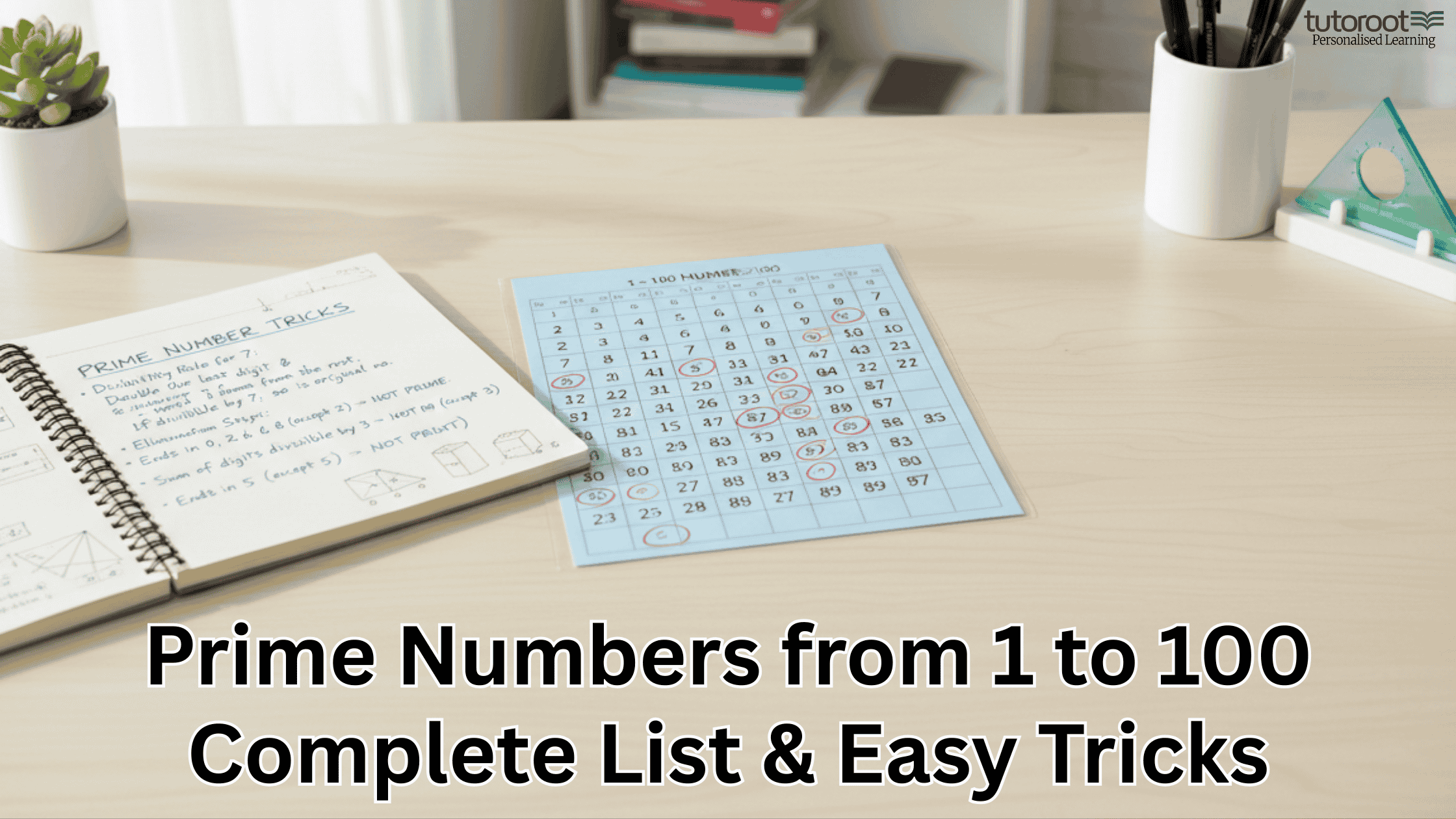
Prime Numbers from 1 to 100: Complete List & Easy Tricks
Prime Numbers from 1 to 100 — Quick Answer
Prime numbers from 1 to 100 are:
2, 3, 5, 7, 11, 13, 17, 19, 23, 29,
31, 37, 41, 43, 47, 53, 59, 61, 67, 71,
73, 79, 83, 89, 97
There are 25 prime numbers between 1 and 100.
Students often search for prime numbers from 1 to 100 before exams, homework, or competitive tests. Sometimes they just need the list. Sometimes they want to understand the concept clearly.
Prime numbers are basic building blocks in maths. You use them in factors, multiples, HCF, LCM, and even algebra later. From Class 6 to Class 10, questions on prime numbers come up.
If your child is confused about what prime numbers are or if they keep forgetting the list, do not worry. In this guide, I will explain everything in a very simple way with examples and tricks.
List of Prime Numbers from 1 to 100
The list of prime numbers from 1 to 100 is as follows:
2, 3, 5, 7, 11, 13, 17, 19, 23, 29
31, 37, 41, 43, 47, 53, 59, 61, 67, 71
73, 79, 83, 89, 97
This is the complete list of prime numbers from 1 to 100.
There are a total of 25 prime numbers.
What Are Prime Numbers?
Many students ask, what are prime numbers from 1 to 100?
A prime number is a number that has exactly two factors:
- 1
- The number itself
That’s it.
For example:
7 is prime because it is divisible only by 1 and 7.
13 is prime because it is divisible only by 1 and 13.
Now compare that with 8.
8 can be divided by 1, 2, 4, and 8. So it has more than two factors. That makes it a composite number.
Important:
- 1 is NOT a prime number because it has only one factor.
- Understanding this small rule clears most confusion.
How to Find Prime Numbers from 1 to 100
Students often ask, how to find prime numbers from 1 to 100 without memorizing everything?
Let’s look at simple methods.
Division Method
Pick a number.
Check if it divides evenly by any number other than 1 and itself.
Example:
Is 19 prime?
Try dividing by 2, 3, 4, and 5.
None divide exactly. So, 19 is prime.
This method works well for smaller numbers.
Sieve of Eratosthenes Method
Schools often teach this method.
Write numbers from 1 to 100.
- Cross out 1 (not prime).
- Circle 2. Cross out all multiples of 2.
- Circle 3. Cross out multiples of 3.
Continue the process.
The remaining uncrossed numbers are prime.
This method is systematic and reduces mistakes.
Quick Mental Check
For exam speed:
- Ignore even numbers (except 2).
- Ignore numbers ending in 5 (except 5).
- Check divisibility by 3 using digit sum.
- These shortcuts save time during MCQs.
Easy Tricks to Identify Prime Numbers Faster
Students often lose marks due to small mistakes. These quick rules help:
- Last Digit Rule
Except 2 and 5, prime numbers do not end in 0, 2, 4, 5, 6, or 8.
- Sum of Digits Rule
If the sum of digits is divisible by 3, the number is not prime.
Example: 21 → 2+1=3 → divisible by 3 → not prime.
- Only One Even Prime
Remember: 2 is the only even prime number.
- Memory Tip
Break the list into small groups of five. Revise daily for one week. It becomes permanent.
Small tricks reduce exam stress.
Why Prime Numbers Are Important in Maths
Many students ask, “Why do we even need this?”
Prime numbers help in:
- Finding HCF and LCM
- Solving fraction problems
- Understanding factors and multiples
- Learning algebra
- Preparing for competitive exams
In higher classes, prime numbers are even used in coding and cryptography.
So yes, this topic is basic, but very important.
Prime Numbers Chart from 1 to 100
Here is a simple table for quick revision:
| Range | Prime Numbers |
| 1-10 | 2, 3, 5, 7 |
| 11-20 | 11, 13, 17, 19 |
| 21-30 | 23, 29 |
| 31-40 | 31, 37 |
| 41-50 | 41, 43, 47 |
| 51-60 | 53, 59 |
| 61-70 | 61, 67 |
| 71-80 | 71, 73, 79 |
| 81-90 | 83, 89 |
| 91-100 | 97 |
Use this chart before exams for quick recall.
Common Mistakes Students Make with Prime Numbers
Let’s fix some common errors:
- Thinking 1 is a prime number
- Forgetting that 2 is the only even prime
- Confusing 9 or 21 as prime
- Memorizing without understanding
Many students lose easy marks because of these small confusions.
Understanding the rule properly saves time and boosts confidence.
FAQs
Q1. How many prime numbers are there from 1 to 100?
There are 25 prime numbers from 1 to 100.
Q2. Is 1 a prime number?
No. 1 has only one factor. A prime number must have exactly two factors.
Q3. What is the largest prime number under 100?
97 is the largest prime number below 100.
Q4. What is the smallest prime number?
2 is the smallest prime number. It is also the only even prime number.
Q5. How to remember prime numbers easily?
Break them into small groups. Practice writing them daily for one week. Use divisibility tricks during exams instead of blind memorization.
Master Prime Numbers Easily with Tutoroot
The concept of prime numbers up to 100 becomes easy to understand when children are able to grasp concepts rather than memorize blindly.
When children can grasp concepts with the help of proper explanations and tricks, they begin to solve questions related to prime numbers with confidence. They don’t guess anymore. They begin to understand.
The problem of understanding maths basics or losing marks in simple concepts is not an ability issue but a clarity problem. Improvement is steady when the right help is provided.
Tutoroot’s personalised online tuition classes focuses on strong fundamentals, patient doubt-solving, and regular practice. Step by step, students build confidence and perform better in exams.
When concepts are clear, maths no longer feels stressful.