
What Is the Carbon Cycle? Diagram, Steps, and Importance
Carbon is one of the most important elements on Earth. It exists in the air, water, soil, and in all living organisms. But have you ever wondered how carbon keeps moving between living things and the environment? This continuous movement is called the carbon cycle.
Understanding what is the carbon cycle helps students learn how nature maintains balance in ecosystems and supports life on Earth. It is also an important concept in school science and environmental studies.
Many students learn this topic in Class 9 or 10 science, but understanding the steps clearly can sometimes be confusing. With the help of structured learning methods such as biology online tuition, students can break down complex science topics and understand them more clearly.
In this article, we will understand what the carbon cycle is, its steps, diagram explanation, and why it is important for life on Earth.
What Is the Carbon Cycle?
The carbon cycle is the natural process through which carbon moves between the atmosphere, living organisms, oceans, and the Earth’s surface.
In simple words, the carbon cycle is the continuous circulation of carbon between living and non-living components of the Earth.
Carbon is present in different forms such as:
- Carbon dioxide in the atmosphere
- Organic molecules in plants and animals
- Carbon compounds in soil
- Fossil fuels like coal and petroleum
- Carbon dissolved in oceans
Through processes like photosynthesis, respiration, decomposition, and combustion, carbon keeps moving from one part of the Earth to another.
Carbon Cycle Diagram Explanation
The carbon cycle diagram shows how carbon travels through different parts of nature.
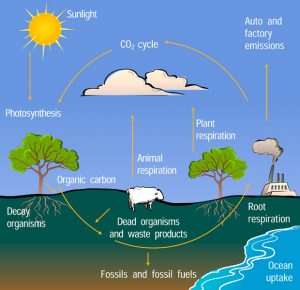
The main components shown in the diagram usually include:
- Atmosphere (carbon dioxide)
- Plants
- Animals
- Soil
- Fossil fuels
- Oceans
The cycle starts when plants absorb carbon dioxide from the atmosphere. Animals then consume plants, transferring carbon into their bodies. When organisms respire, decompose, or burn fuels, carbon is released back into the atmosphere.
Understanding this diagram helps students clearly visualize how carbon flows through ecosystems.
Main Steps of the Carbon Cycle
The carbon cycle works through several natural processes. Each step plays an important role in maintaining balance in the environment.
1. Photosynthesis
Photosynthesis is the process by which plants absorb carbon dioxide from the atmosphere and convert it into food using sunlight.
During this process:
- Plants take in carbon dioxide
- Use sunlight and water
- Produce glucose and oxygen
This step moves carbon from the atmosphere into living organisms.
2. Respiration
Respiration is the process through which plants, animals, and humans release carbon dioxide back into the atmosphere.
When living organisms break down food to release energy, carbon dioxide is produced as a by-product.
This step returns carbon to the air and keeps the cycle moving.
3. Consumption
Animals obtain carbon by eating plants or other animals.
When animals consume food:
- Carbon stored in plants enters animal bodies
- It becomes part of tissues and energy molecules
This transfers carbon through different levels of the food chain.
4. Decomposition
When plants and animals die, microorganisms like bacteria and fungi break down their bodies.
During decomposition:
- Carbon compounds are released into soil
- Some carbon returns to the atmosphere as carbon dioxide
This process recycles carbon back into nature.
5. Combustion
Combustion occurs when fossil fuels like coal, oil, or natural gas are burned.
Burning fuels releases large amounts of carbon dioxide into the atmosphere.
Human activities such as:
- Industrial processes
- Vehicles
- Power plants
have increased carbon emissions in recent years.
Importance of the Carbon Cycle
The carbon cycle is extremely important because it helps maintain balance in nature.
1. Supports Life on Earth
Carbon is a key element in all living organisms. It forms the building blocks of proteins, carbohydrates, fats, and DNA.
2. Maintains Atmospheric Balance
The carbon cycle helps regulate the amount of carbon dioxide in the atmosphere, which is important for maintaining Earth’s climate.
3. Supports Plant Growth
Plants use carbon dioxide during photosynthesis to produce food. This supports the entire food chain.
4. Regulates Earth’s Temperature
Carbon dioxide acts as a greenhouse gas that helps keep Earth’s temperature suitable for life.
However, too much carbon dioxide can contribute to global warming.
Human Impact on the Carbon Cycle
Human activities have significantly affected the natural carbon cycle.
Some major impacts include:
- Burning fossil fuels
- Deforestation
- Industrial emissions
- Increased transportation
These activities release excessive carbon dioxide into the atmosphere, which contributes to climate change.
Understanding the carbon cycle helps us realize the importance of protecting forests and reducing carbon emissions.
How Students Can Understand the Carbon Cycle Easily
Many students find environmental science topics difficult because they involve multiple steps and processes.
Learning through visual explanations, diagrams, and real-life examples can make the concept much easier.
Interactive learning formats such as online tuition allow students to ask questions, understand diagrams clearly, and strengthen their overall science fundamentals.

Master Biology Subject with Tutoroot
The carbon cycle is one of the most important natural processes that keeps life on Earth functioning smoothly. It continuously moves carbon between the atmosphere, plants, animals, soil, and oceans.
Processes like photosynthesis, respiration, decomposition, and combustion ensure that carbon keeps circulating through ecosystems.
By understanding what the carbon cycle is and how it works, students can better appreciate the delicate balance that supports life on our planet.
If you want to strengthen your understanding of science topics and prepare confidently for exams, learning with expert guidance can make a big difference. Platforms like Tutoroot provide personalized online tutoring that helps students simplify complex concepts and build strong academic foundations.
FAQs About the Carbon Cycle
1. What is the carbon cycle in simple words?
The carbon cycle is the continuous movement of carbon between the atmosphere, plants, animals, soil, and oceans through natural processes like photosynthesis and respiration.
2. Why is the carbon cycle important?
The carbon cycle is important because it helps maintain the balance of carbon dioxide in the atmosphere and supports life on Earth.
3. What are the main steps of the carbon cycle?
The main steps include photosynthesis, respiration, consumption, decomposition, and combustion.
4. How do humans affect the carbon cycle?
Humans affect the carbon cycle by burning fossil fuels, cutting forests, and increasing industrial emissions, which release large amounts of carbon dioxide into the atmosphere.
5. In which class do students learn about the carbon cycle?
Students usually learn about the carbon cycle in middle school and secondary school science, especially in environmental science and biology topics.

Your article helped me a lot, is there any more related content? Thanks!
Your point of view caught my eye and was very interesting. Thanks. I have a question for you.
Thanks for sharing. I read many of your blog posts, cool, your blog is very good. https://www.binance.info/id/register?ref=UM6SMJM3