
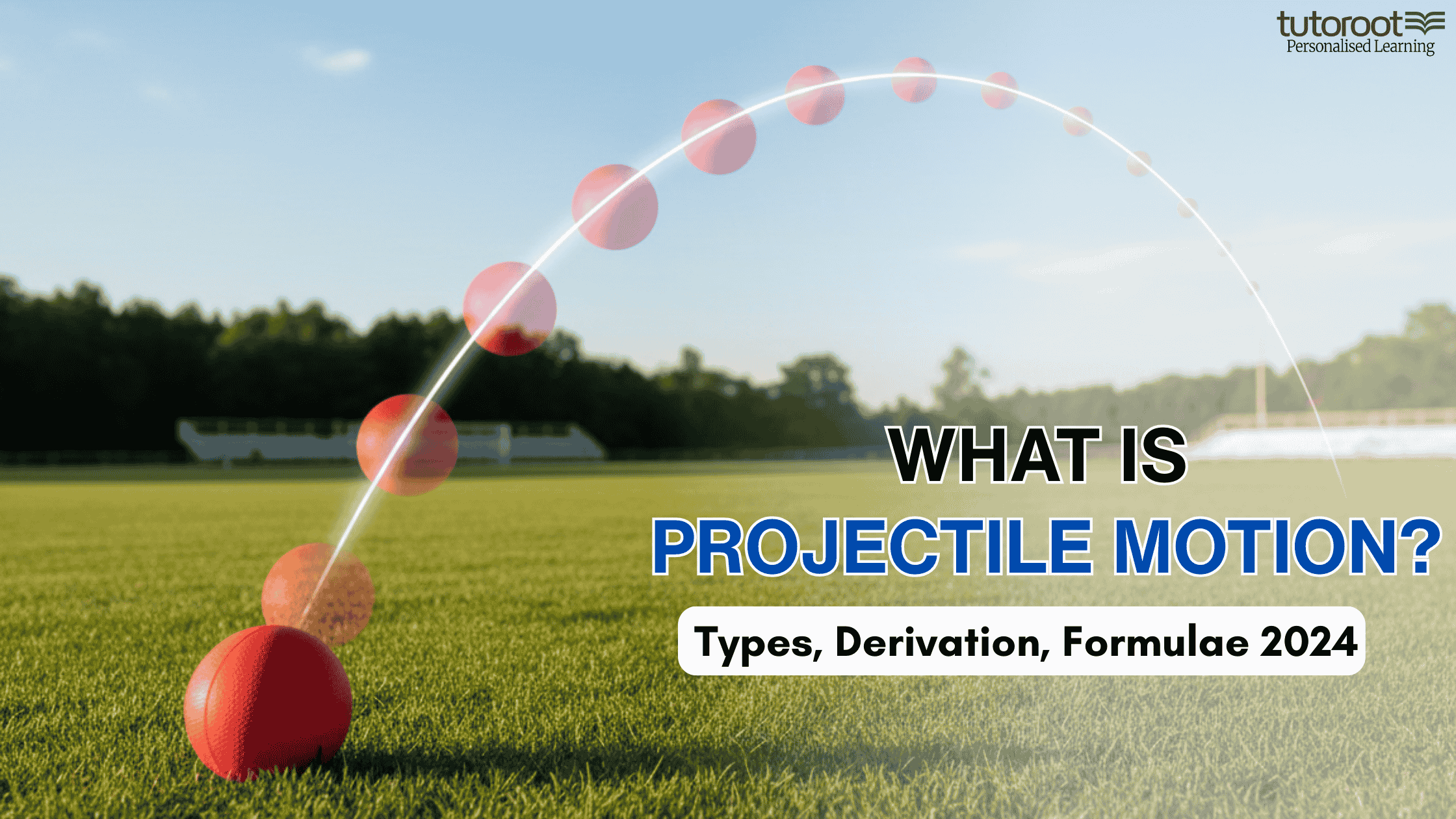
What is Projectile Motion? – Types, Derivation, Formulae 2024
Have you ever wondered why a thrown basketball follows a curved arc rather than a straight line? That curve is the result of Projectile Motion. Whether it’s a high-flying satellite or a simple stone skipped across a pond, the physics remains the same.
What is a Projectile?
A projectile is any object thrown, kicked, or launched into space that moves under the influence of gravity. While air resistance exists in the real world, in standard physics problems, we consider gravity to be the only significant force acting on the object. The path the object follows is called its trajectory.
What is Projectile Motion?
Projectile motion is a form of motion experienced by an object projected into the air, moving along a curved path under the action of gravity.
The most important rule to remember is that projectile motion consists of two independent components:
-
Horizontal Component (x-axis): There is no acceleration (ignoring air friction). The velocity remains constant.
-
Vertical Component (y-axis): The object experiences a constant downward acceleration due to gravity ($g \approx 9.8 \text{ m/s}^2$).
Types of Projectile Motion
Not all launches are the same. We generally categorize them into three types:
| Type | Description | Example |
| Oblique Projectile | Launched at an angle ($\theta$) to the horizontal. | A football kickoff. |
| Horizontal Projectile | Launched perfectly flat from a specific height. | A package dropped from a moving plane. |
| Inclined Plane Projectile | Launched onto a slope or from a sloped surface. | Hitting a golf ball up a hill. |
The Parabolic Path
Why is the path a parabola? This occurs because the horizontal distance increases linearly with time, while the vertical distance changes quadratically due to gravity. When you combine a constant horizontal motion with an accelerating vertical motion, the mathematical result is always a parabola.
Key Projectile Motion Equations
To solve for displacement, velocity, and time, we use the standard equations of motion. Let $u$ be the initial velocity, $\theta$ be the launch angle, and $g$ be the acceleration due to gravity.
1. Time of Flight ($T$)
The total time the object stays in the air:
2. Maximum Height ($H$)
The highest vertical point reached by the projectile:
3. Horizontal Range ($R$)
The total horizontal distance covered:
Frequently Asked Questions (FAQ)
What is the best angle for maximum range?
For a projectile launched and landing at the same height, an angle of 45° provides the maximum horizontal distance.
Does the mass of the object affect projectile motion?
In a vacuum (ignoring air resistance), mass does not affect the trajectory. A bowling ball and a tennis ball thrown at the same velocity and angle will follow the exact same path.
What is the acceleration of a projectile at its peak?
At the very top of the arc, the vertical velocity is zero, but the acceleration is still $9.8 \text{ m/s}^2$ downward. Gravity never stops acting on the object!

Master Physics with Tutoroot
Struggling to visualize these trajectories or calculate complex ranges? Physics is easier when you have an expert to guide you. Tutoroot’s interactive online classes provide personalized coaching, high-quality study materials, and real-time doubt-clearing sessions to help you ace your exams.
Ready to level up your grades? [Book a Free Demo Class with Tutoroot today!]