
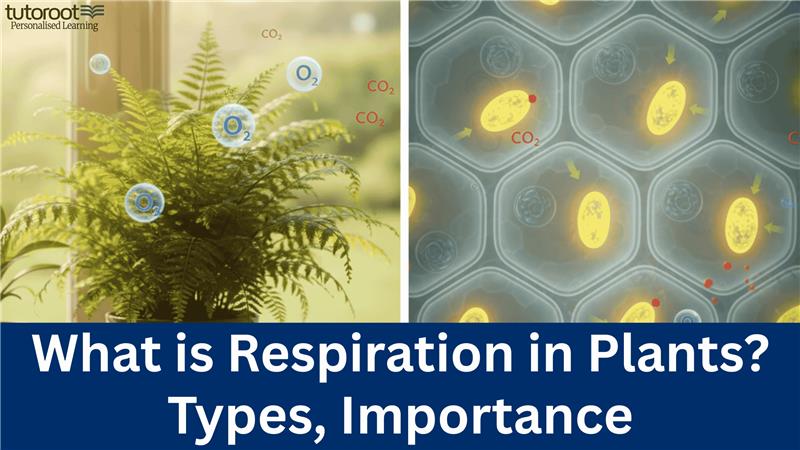
What is Respiration in Plants? – Types, Importance
Introduction
Respiration is the “silent engine” of life. While plants appear stationary, they are constantly working at a cellular level. Unlike photosynthesis, which stores energy, respiration releases energy. In this guide, we’ll break down how plants breathe, the chemical equations you need for exams, and how different organs—from roots to fruits—play their part.
What is Respiration in Plants?
Respiration is a biochemical process where plants break down glucose (organic molecules) to create Adenosine Triphosphate (ATP). Think of ATP as the “energy currency” of the plant. Without it, a plant cannot grow, reproduce, or defend itself against pests.
The Respiration Equation
For your board exams, you must remember this balanced relationship. Plants take in glucose and oxygen to produce energy, leaving carbon dioxide and water as byproducts.
$$C_6H_{12}O_6 + 6O_2 \rightarrow 6CO_2 + 6H_2O + \text{Energy (ATP)}$$
Types of Respiration: Aerobic vs. Anaerobic
Plants don’t always breathe the same way. Depending on oxygen availability, they use two methods:
-
Aerobic Respiration: * Condition: Occurs in the presence of oxygen.
Efficiency: High energy release (36-38 ATP).
Outcome: Complete breakdown of glucose into $CO_2$ and water.
-
Anaerobic Respiration: * Condition: Occurs when oxygen is absent (e.g., waterlogged roots).
Efficiency: Low energy release (2 ATP).
Outcome: Partial breakdown, producing Ethanol or Lactic Acid.
Check out our deep dive: [Aerobic And Anaerobic Respiration – Definition & Differences]
How Different Plant Parts “Breathe”
Unlike humans, plants don’t have lungs. Instead, every part of the plant takes care of its own gas exchange.
Roots: They absorb oxygen trapped between soil particles. Pro Tip: If you overwater a plant, the roots can’t get oxygen and may switch to anaerobic respiration, leading to “root rot.”
Stems: In woody plants, small openings called Lenticels allow for gas exchange. In green stems, stomata do the work.
Leaves: The primary site of respiration. Stomata (tiny pores) act as gates, letting $O_2$ in and $CO_2$ out.
Flowers & Fruits: These organs have high metabolic rates. They respire heavily during pollination and ripening to fuel rapid cell division.
Key Differences: Plant vs. Animal Respiration
It is a common misconception that they are the same. Here’s the reality:
-
Rate: Plant respiration is much slower than animal respiration.
-
Transport: Plants don’t transport gases over long distances; animals use blood/hemoglobin.
-
Organs: Animals use lungs/gills; plants use Stomata, Lenticels, and Root hairs.

Summary & Final Notes
Respiration is the lifeline of the plant kingdom. It allows a seedling to push through the soil and a tree to stand tall for centuries. For Class 10 students, mastering the ATP yield and the Stomatal mechanism is the key to scoring high in Biology.
Ready to master more complex concepts? Explore the Tutoroot for simplified guides. Boost your grades with personalized attention—[Schedule your FREE DEMO session with Tutoroot today!]