
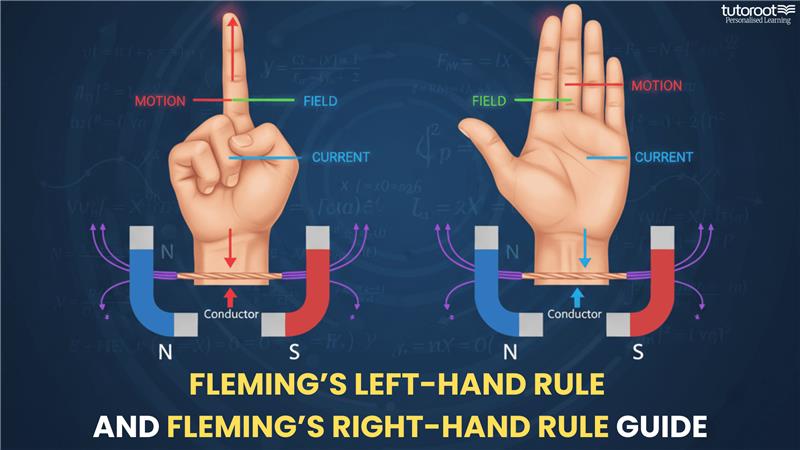
Fleming’s Left-Hand Rule and Fleming’s Right-Hand Rule Guide
Understanding the interaction between electricity and magnetism is a cornerstone of Physics. However, visualizing how force, current, and magnetic fields interact in three dimensions can be tricky. This is where Fleming’s Rules come in. These “handy” mnemonics are essential for solving problems related to motors and generators.
1. Fleming’s Left-Hand Rule (The Motor Rule)
Fleming’s Left-Hand Rule is used to determine the direction of force (motion) acting on a current-carrying conductor when it is placed in an external magnetic field. This principle is the foundation behind how electric motors work.
How to use it:
Stretch the thumb, index finger, and middle finger of your left hand so that they are mutually perpendicular (at $90^\circ$ to each other).
-
-
Thumb: Points in the direction of the Force (F) or Motion.
-
Index Finger: Points in the direction of the Magnetic Field (B) (North to South).
-
Middle Finger: Points in the direction of the Current (I) (Positive to Negative).
-
2. Fleming’s Right-Hand Rule (The Generator Rule)
While the left hand is for motors, the Right-Hand Rule is used for electric generators. It helps find the direction of the induced current when a conductor moves inside a magnetic field.
How to use it:
Stretch the thumb, index finger, and middle finger of your right hand perpendicular to each other.
-
-
Thumb: Points in the direction of the Motion of the conductor relative to the magnetic field.
-
Index Finger: Points in the direction of the Magnetic Field (B).
-
Middle Finger: Points in the direction of the Induced Current (I).
-
Key Differences: Fleming’s Rules Left-Hand vs. Right-Hand Rule
It is easy to confuse the two. Use this table for a quick comparison:
| Feature | Fleming’s Left-Hand Rule | Fleming’s Right-Hand Rule |
| Primary Use | Electric Motors | Electric Generators |
| Goal | Find direction of Force/Motion | Find direction of Induced Current |
| Input | Current and Magnetic Field | Motion and Magnetic Field |
| Application | Converting Electrical to Mechanical energy | Converting Mechanical to Electrical energy |
Frequently Asked Questions (FAQ)
What does the thumb represent in Fleming’s Left-Hand Rule?
The thumb indicates the direction of the Magnetic Force (Motion) acting on the conductor.
How do I remember which hand to use for motors and generators?
A simple trick is the “MG” rule: Motor = Left (think of the ‘L’ in ‘Left’), and Generator = Right. Another way is to remember that Generators are “Right” for producing electricity.
Is Fleming’s Right-Hand Rule the same as the Right-Hand Thumb Rule?
No. The Right-Hand Thumb Rule (or Maxwell’s Corkscrew Rule) is used to find the direction of a magnetic field around a straight wire. Fleming’s Right-Hand Rule is specifically for induced current in a moving conductor.
Why must the fingers be perpendicular?
The mathematical relationship between force, field, and current involves the vector cross product. These forces are at their maximum when the components are at 90 degrees to each other.

Boost Your Physics Grades with Tutoroot
Visualizing 3D physics concepts like electromagnetism is much easier with a mentor. If you’re preparing for competitive exams or struggling with classroom concepts, Tutoroot offers personalized, interactive online class tution tailored to your pace.
Get expert guidance, high-quality study materials, and 1-on-1 support to master Physics effortlessly.
2 thoughts on “Fleming’s Left-Hand Rule and Fleming’s Right-Hand Rule Guide”