
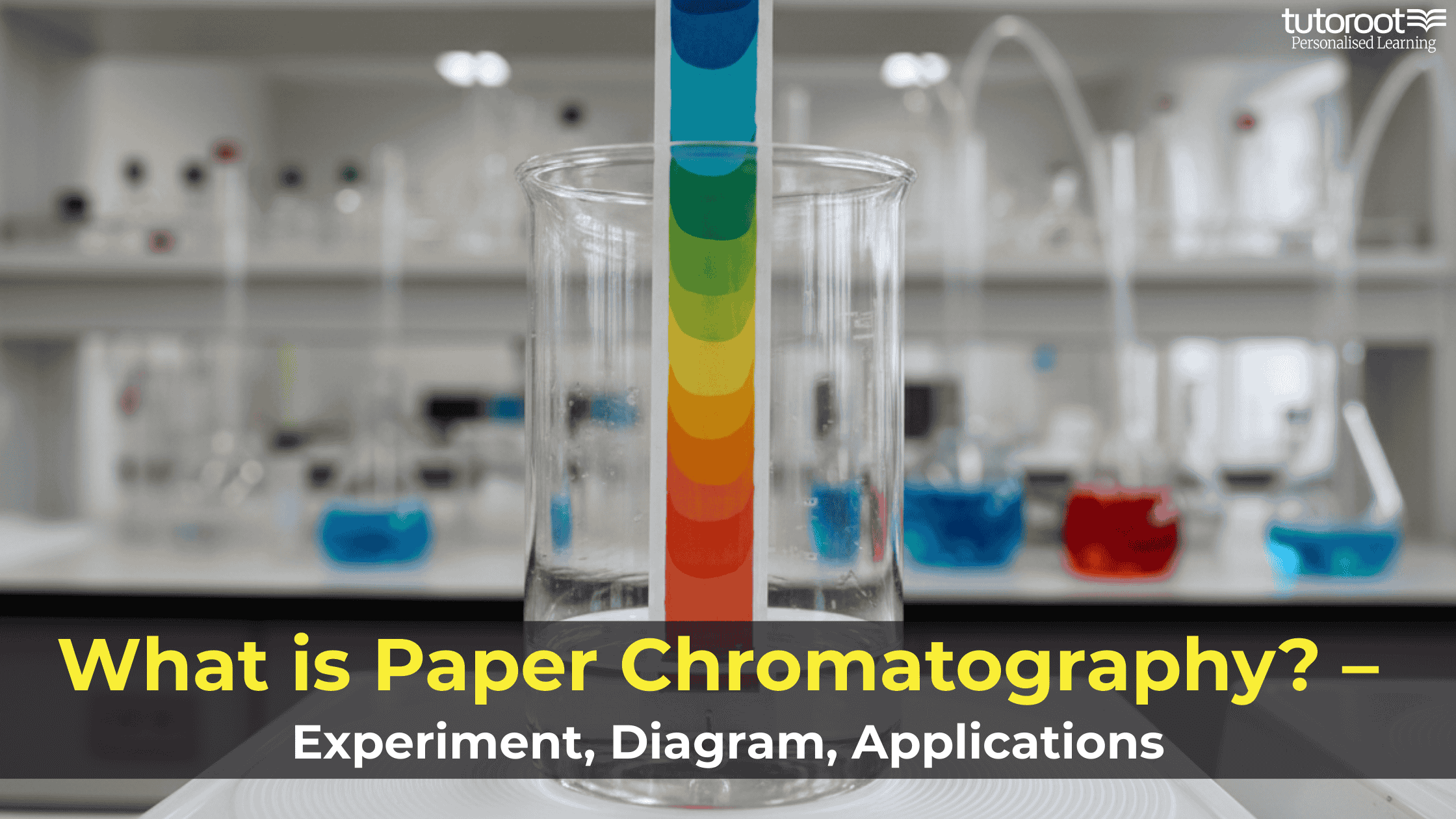
What is Paper Chromatography? – Experiment, Diagram, Applications
Paper chromatography is a widely used analytical technique that helps scientists and students separate and identify different substances in a mixture. It works by using paper as the stationary phase and a solvent as the mobile phase.
In chemistry laboratories, researchers use this method to analyze pigments, dyes, and other chemical compounds. Moreover, it is simple, cost-effective, and easy to perform in school laboratory experiments.
Because of these advantages, the technique plays an important role in chemistry education, forensic investigations, environmental testing, and pharmaceutical analysis.
In this guide, you will learn the principle of paper chromatography, types, experiment procedure, diagram explanation, and real-world applications.
What is Paper Chromatography?
Paper chromatography is a laboratory technique used to separate the components of a mixture using chromatography paper and a liquid solvent.
First, a small amount of the sample mixture is placed on the paper. Then the solvent moves through the paper due to capillary action. As a result, different substances travel at different speeds depending on their chemical properties.
Consequently, the components separate and form distinct spots on the paper, which scientists call a chromatogram.
Students commonly perform this experiment to separate:
-
ink pigments
-
plant pigments
-
food colouring
-
amino acids
Therefore, this technique is widely used in school chemistry experiments and laboratory analysis.
Principle of Paper Chromatography
The principle of paper chromatography mainly depends on partition and capillary action.
When the solvent moves upward through the paper, it carries the mixture along with it. However, each substance interacts differently with the solvent and the paper.
Because of these differences, some substances move faster while others move more slowly. As a result, the mixture separates into individual components.
Therefore, the separation occurs because of two important factors:
-
Solubility of the substance in the solvent
-
Attraction between the substance and the paper
This process ultimately produces clear separation of the mixture components.
How Paper Chromatography Works
The working process of paper chromatography follows a few simple steps.
First, the sample mixture is applied as a small spot near the bottom of the paper. After that, the paper is placed inside a container that contains the solvent.
Next, the solvent slowly travels upward through the paper because of capillary action. While the solvent moves, it carries the mixture components along with it.
However, each component interacts differently with the solvent and the paper. Consequently, the substances move at different speeds and separate into visible spots.
Finally, the separated spots form a chromatogram, which helps scientists identify the components present in the mixture.
Paper Chromatography Experiment Procedure
Students frequently perform experiments in school laboratories.
Follow these steps to conduct the experiment correctly.
Step 1: Prepare the Paper
First, cut a strip of chromatography paper and draw a pencil line near the bottom.
Step 2: Apply the Sample
Next, place a small drop of ink or pigment on the pencil line using a capillary tube.
Step 3: Prepare the Solvent
Then pour the solvent into a beaker or jar.
Step 4: Place the Paper
Carefully place the paper strip inside the container. Make sure the sample spot stays above the solvent level.
Step 5: Allow Separation
After a few minutes, the solvent moves upward and separates the mixture components.
Step 6: Observe Results
Finally, remove the paper and allow it to dry. You will notice different colored spots that represent separated substances.

Frequently Asked Questions (FAQs)
What is paper chromatography in simple words?
Paper chromatography is a laboratory technique used to separate different components of a mixture using paper and a solvent. As the solvent moves through the paper, each substance travels at a different speed, which helps separate the mixture into individual parts.
What is the main principle of paper chromatography?
The principle of paper chromatography is based on partition and capillary action. The solvent moves through the paper and carries the mixture components with it. Because each component interacts differently with the solvent and paper, they move at different speeds and get separated.
What is the Rf value in paper chromatography?
Rf value (Retention Factor) is used to identify substances in chromatography.
Formula:
Rf = Distance travelled by the substance ÷ Distance travelled by the solvent
Scientists compare Rf values to determine the identity of unknown compounds.
What are common examples of paper chromatography experiments?
Common examples include:
-
Separating ink colours from a marker
-
Identifying plant pigments from leaves
-
Analysing food colouring agents
-
Detecting chemical compounds in laboratories
These experiments are commonly performed in school chemistry practical labs.
Learn Chemistry Easily with Tutoroot Online Tuition
Tutoroot Online Tuition helps students understand chemistry concepts like paper chromatography, chemical reactions, and separation techniques in a clear and simple way. Instead of relying only on textbooks, students learn through interactive one-to-one live classes with experienced tutors. Moreover, expert teachers use visual diagrams, practical examples, and step-by-step explanations to make complex topics easier to understand. As a result, students improve their subject knowledge, clear doubts quickly, and prepare confidently for CBSE, ICSE, and other school exams. Book a FREE demo class today to experience Tutoroot’s personalized online learning.